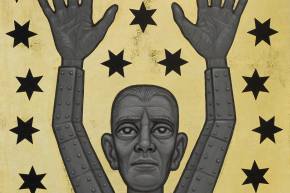


In September 1969, the Czech artist Jiří Kolář became one of the eight international artists awarded the biennale prize at the 10th São Paulo Biennial. Based on the photographs preserved in the biennale archive, the present exhibition provides a partial reconstruction of Kolář’s award-winning presentation by bringing together artworks traced in Czech museum collections, including the collection of the National Gallery in Prague. The works are complemented by archival material revealing various aspects of his participation in the prestigious yet also contested biennale.
Since its foundation in 1951, the São Paulo Biennale became a site of encounter between art from South and North Americas, Western Europe, and gradually also the Eastern Bloc and the Global South. From its first participation in 1957 until the 10th edition in 1969, Czechoslovak exhibitions were curated by Jiří Kotalík, since 1967 the Director of the National Gallery in Prague. At the 10th edition, co-curated by the Slovak art historian Marian Váross, Czechoslovakia was represented – besides a larger collection of works by Jiří Kolář – by the Czech artists František Ronovský and Jiří Novák, and the Slovak artists Miloš Urbásek, Milan Dobeš, and Michal Jakabčic. While their works showed diverse approaches to art in Czechoslovakia in the period leading up to the Prague Spring in 1968, they were shown in São Paulo more than a year after the August 1968 Warsaw Pact invasion of Czechoslovakia.
In the history of the biennale, the 10th edition remains notorious for its boycott by numerous Brazilian and international artists in protest of the censorship and systemic human rights abuses committed by the Brazilian military dictatorship. Despite awareness of the boycott at the state level, it remains unclear how much information was available to artists in Czechoslovakia. Jiří Kolář’s decision to decline an interview for the magazine Výtvarná práce could be read as a notable silence. Shortly afterwards, Kolář himself became subject to state persecution in Czechoslovakia. The exhibition thus also raises unsettling questions about the position of artists navigating complex political situations both at home and in the places where their work is exhibited.
Venue: Trade Fair Palace, 2nd floor, exhibition 1939–2021: The End of the Black-and-White Era
Curator: Rado Ištok
Curator: Rado Ištok